“Meditation” is a term that everyone is familiar with. Videos, articles, and content are abundant on the internet about meditation and its incredible benefits. These resources often inspire us to start meditating immediately. However, many people give up at the beginning because they find meditation to be complicated. It requires patience, perseverance, and a lot of practice, which is challenging for everyone.
But let’s delve into a different perspective on meditation.
Whether knowingly or unknowingly, we all engage in meditation…
Everyone meditates on something, even if they are unaware of it. Let’s consider some examples.
If we observe our daily lives closely, we will find that a mother meditates on her child, constantly concerned about their well-being.
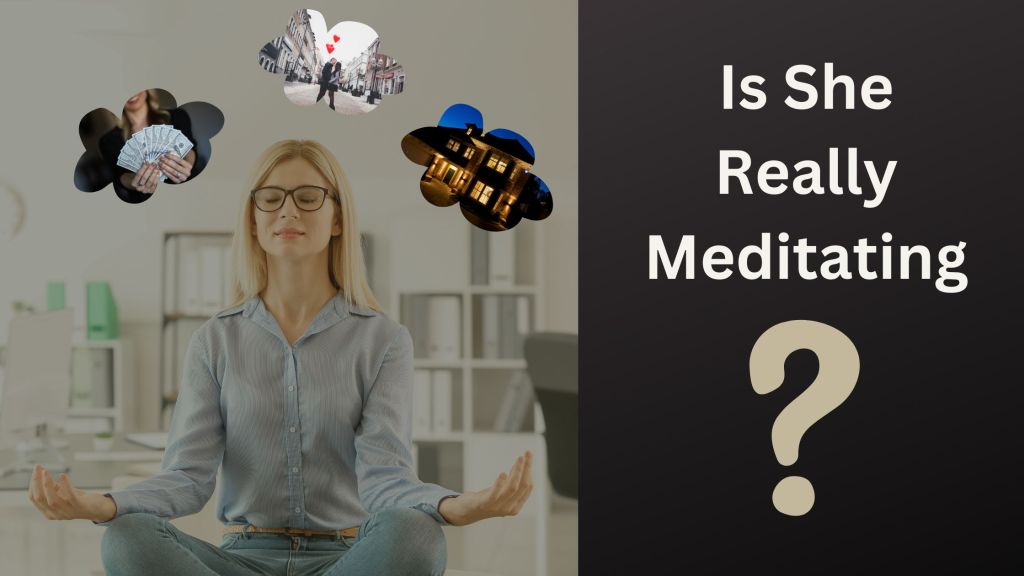
Businesspeople often meditate on money, while politicians meditate on power. Youngsters may meditate upon romantic interests, and intellectuals ponder books. Brokers constantly think about stocks and so on…
Therefore, everyone meditates on something.
Meditation refers to what the mind or consciousness is focused upon. Many believe that sitting down with crossed legs and closed eyes is spiritual meditation. However, if a person sits with closed eyes but thinks about money or worldly matters, it does not necessarily constitute spiritual meditation.
Furthermore, some believe natural meditation entails emptying the mind of all material forms, thoughts, problems, and concerns. While this perspective holds some truth, it is not the entirety of actual or spiritual meditation. When individuals have nothing else to focus on, they attempt to clear their minds by fixating on sound vibrations. They aim to push away all other thoughts and blank their minds. However, this is also not true meditation.
So, what is actual meditation?
To engage in actual meditation, we must first understand our true identity. Without this understanding, we may attempt to meditate but ultimately fail to attain spiritual realization.
Our true identity is that of spirit souls embodied in temporary material bodies composed of gross and subtle material elements. The five gross elements are earth, water, fire, air, and ether, while the three subtle elements are mind, false ego, and intelligence.
As spirit souls, also known as Atma, we are eternal beings who never take birth or die. We change bodies according to our desires and past karmic reactions. The Bhagavad-Gita beautifully describes the true identity of the living entity as stated by the Supreme Lord:
For the soul, there is never birth nor death. Nor, having once been, does he ever cease to be. He is unborn, eternal, ever-existing, undying, and primeval. He is not slain when the body is slain.
Bhagavad-Gita 2:20
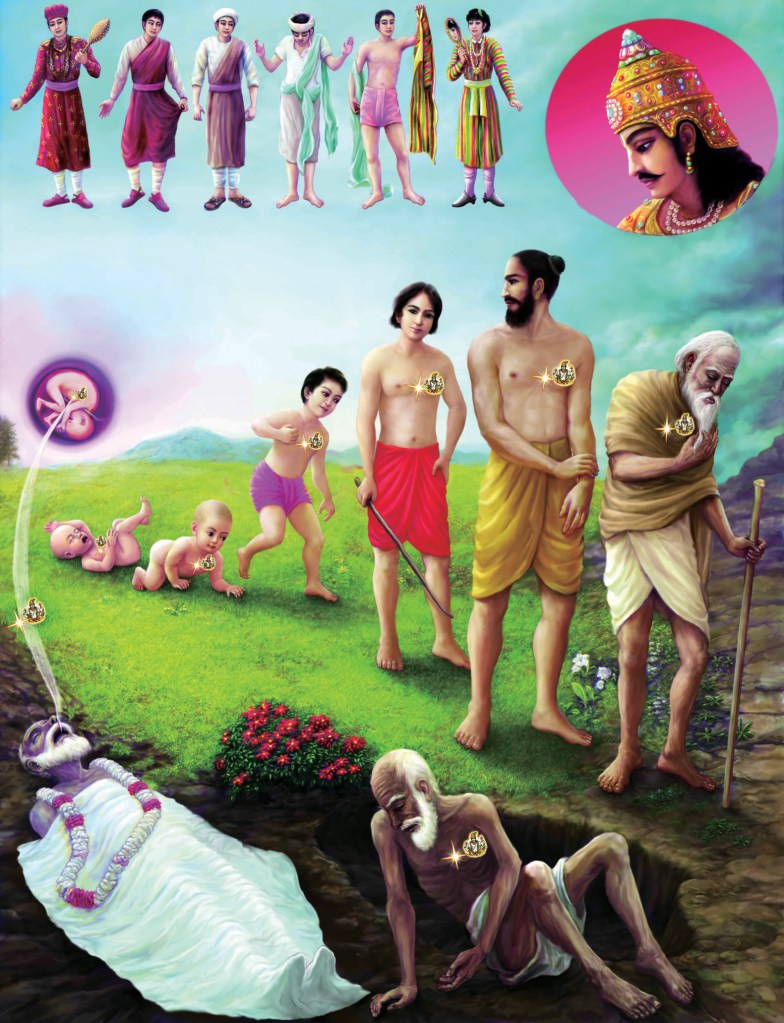
In our current state, we exist in a material world where everything is temporary. Our lives are plagued by suffering due to the inevitable cycle of birth, aging, illness, and death. We will endure these challenges as long as we remain within this material realm, which is rife with hardships. We are an integral part of the Supreme Lord, and our true nature is spiritual. No matter how much we indulge in worldly pleasures or lead a life of luxury, we can never find lasting satisfaction in these material pursuits.
Our inner yearning can only be fulfilled through spiritual nourishment. This craving prompts us to cultivate a connection with the Supreme Lord because we share in His eternal nature as parts of God. We belong to the realm of the eternal spiritual world.
The living entities in this conditioned world are My eternal, fragmental parts. Due to conditioned life, they struggle very hard with the six senses, including the mind.
Bhagavad Gita 15:7
When we understand this reality and develop a loving relationship with God, we eliminate the material miseries and enter into the kingdom of God, which is eternal & spiritually blissful. After attaining that kingdom, we don’t return to these miserable conditions of the material world.
Yet there is another nature, which is eternal and is transcendental to this manifested and unmanifested matter. It is supreme and is never annihilated. When all in this world is annihilated, that part remains. That supreme abode is called unmanifested and infallible, and it is the supreme destination. When one goes there, he never comes back. That is My supreme abode.
Bhagavad Gita 8:20 – 21
But the question is, how can we re-establish our connection with God?
In the Vedas, it is said that the process of Bhakti Yoga, or devotional service, is the only way to develop our relationship with God. Bhakti Yoga means keeping one’s consciousness on the Supreme Personality of the Godhead in a good way. An atheist also remembers God but is in a denial state. “There’s no God. God doesn’t exist”; this is how he remembers God, but this is not spiritual meditation.
When we keep our consciousness upon God, His beauty, His power, His glory, His words, His pastimes, His transcendental form & His Holy Names, that is called actual meditation.
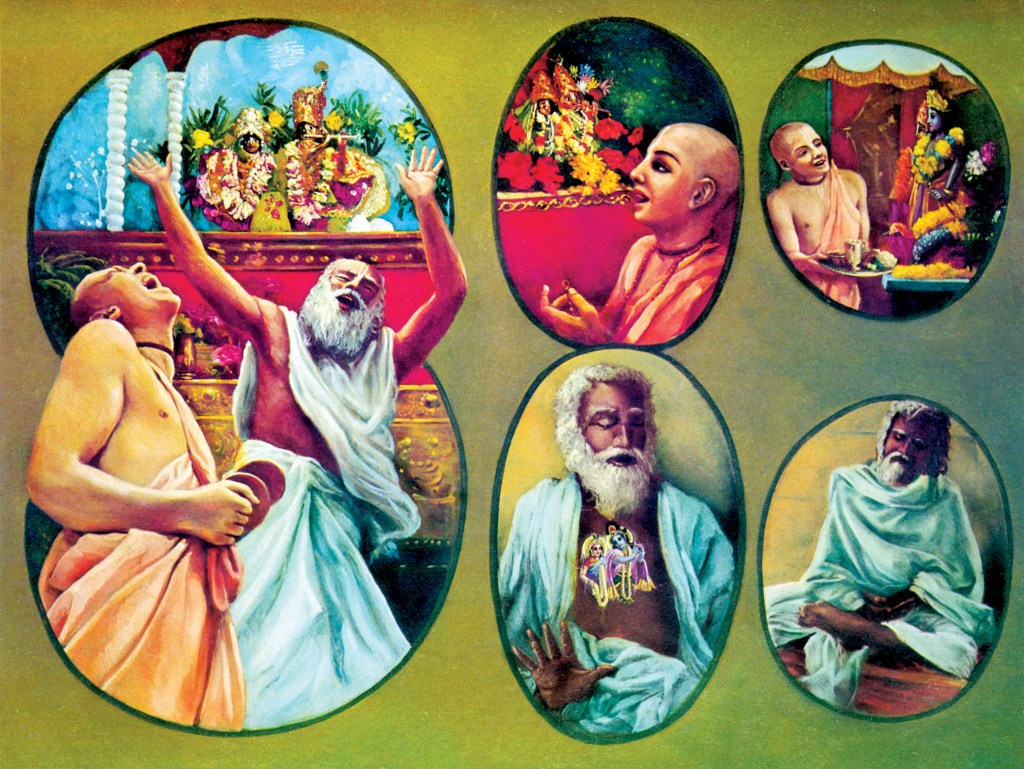
When we meditate on the Supreme Personality of Godhead, we gradually realize our real identity and relationship with Him. Then after leaving our body, we return to Him to His eternal Kingdom and remain engaged in His loving devotional service eternally.
But How Can We Meditate on God When We Can’t See Him?
We can chant and hear sacred mantras and meditate on them. The sacred mantras or the Holy Names of God are non-different from God. God has unlimited names; each name is as spiritually potent as Himself. If we attentively chant and hear the Names of God, then we are doing actual meditation.
A sacred mantra, or Transcendental Sound, comprises various names or descriptions of the Supreme Soul. A Mantra cannot be made up, nor is it composed of mundane words specific to a particular religion or region of the world. It originates in the spiritual realm and descends to the material platform without losing potency, having been handed down orally for countless centuries via a chain of bonafide spiritual masters.
So, when we focus on the Holy Names of the Supreme Lord, our mind and heart gradually get cleansed from all material contaminations, and we progressively experience transcendental bliss.
Mantra Meditation
There are mainly three types of mantra meditation.
- Mantra Meditation with Yoga Breathing
- Japa Meditation
- Kirtan
Mantra Meditation with Yoga Breathing

We feel an ever-deepening inner calm and contentment via the straightforward mantra meditation practice. The mind and nervous system are calmed by slowing down the breath and concentrating on the mantra. This helps us feel relaxed and improves our health in many ways – primarily since so many diseases are caused or aggravated by chronic stress.
You can sit or lie down at your convenience during this process. Then you have to focus on your breathing. Gradually your breathing pace will become slower. Then you chant a mantra in your mind with each inhale and exhale.
You can watch this guided mantra mediation video and apply it.
When you do Mantra Meditation with Yoga Breathing, the added awareness of your breath can help keep the mind anchored on the mantra. When you can focus more closely on the mantra, let it enter the core of your being, and chant from your heart, your meditation becomes much more powerful and effective. You begin to experience deep happiness and joy from repeating the mantra sincerely.
Spiritual love exists within the heart of each of us, but it is covered over, much like a diamond is covered with mud and dirt. The mantra meditation process cleanses that dirt and mud off the diamond of spiritual love.
Jagad Guru Siddhaswarupananda Paramahamsa
Mantra Japa Meditation
Japa meditation, also referred to as Japa Yoga, involves the repetitive chanting of a mantra using beads. This practice is employed in various religious traditions. When we chant the names of God, we engage not only our lips, ears, and mind but also our sense of touch through the use of beads.

The effectiveness of the mantra amplifies when we engage multiple senses in its practice. As humans, we naturally have a tendency to touch and feel things. In Japa Yoga, we channel this inclination towards a spiritual endeavour.
During Japa meditation, as you roll your fingers on each bead, you simultaneously chant the sacred mantras or the names of God. It is crucial to maintain attentive focus and listen to each syllable as you chant the mantra.
To commence your japa meditation practice, I invite you to watch this video in which Jagad Guru Siddhaswarupananda Paramahamsa chants the Mahamantra. Prepare your beads, start playing the video, and engage in chanting for a dedicated period of 10 minutes.
Through regular practice of Japa Meditation, you will gradually witness a decrease in cognitive burdens and insecurities. Moreover, you will experience the blossoming of spiritual happiness and inner peace within your heart.
Kirtan
In this era, the easiest and most impactful meditation technique is Kirtan, also known as Congregational Chanting. It is accessible to everyone and offers tremendous benefits.

Kirtan, often referred to as music meditation, combines elements such as playing musical instruments, singing, chanting, and dancing. However, it can be practiced with or without instruments and in various musical styles. Whether you choose to practice alone, in a small group, or in a large gathering, you have the freedom to chant loudly or softly, dance or remain seated. Kirtan typically follows a call and response format, where one person leads the chanting of a mantra, and others join in unison, repeating the mantra in response.
Kirtan is a deep reservoir of all-satisfying waters that allows you to experience inner peace and spiritual happiness. The more you drink from this reservoir, your heart will be filled with spiritual love and comfort.
Jagad Guru Siddhaswarupananda Paramahamsa
You can watch this video where world-renowned yoga spiritual master Jagad Guru Siddhaswarupananda Paramahamsa sheds light on Kirtan or congregational chanting.
The Proof of the Pudding is in the Eating
You have the option to employ any of the meditation techniques elucidated in this article. Each of these methods holds equal potential to transport you to the realm of spirituality. Regardless of your age, occupation, or social status—be it a student, parent, businessperson, or retiree—we all require a sanctuary from the demands of modern life, stress, anxiety, loneliness, emptiness, and personal challenges.
Much like how people of diverse backgrounds can appreciate a breathtaking sunset, irrespective of their age, income, or profession, similarly, we can all engage in and derive the benefits of yoga meditation.
From the perspective of yoga, a mantra is the sound incarnation of the Supreme Soul, which has the power to reawaken our spiritual love. By resting our heart and mind in this transcendental sound vibration, we make direct contact with the Supreme Soul.
Jagad Guru Siddhaswarupananda Paramahamsa

By incorporating yoga meditation into your life, you can encounter ever-deepening inner peace and joy, gain profound insights, realize your true self-worth, and comprehend the profound and meaningful purpose of your existence.
Mantra meditation stands as the simplest and most sublime approach to revive our dormant connection with the Supreme Lord. Anyone and everyone can attain a state of spontaneous love for God and transform their life into a meditation on God.
Thank you for reading.
This article is inspired by the teachings of world-renowned yoga spiritual master Jagad Guru Siddhaswarupananda Paramahamsa.
 LetItGrow.org