Humility is often hailed as one of the most crucial virtues for success and personal growth. Humility is not about diminishing oneself or lacking confidence but about shifting our focus away from self-centeredness to a more respectful and open-minded approach towards others.
In essence, humility involves showing respect for others, being open to their perspectives, and allowing space for their experiences without passing judgment.
By nurturing humility, you invite positive growth in every important area of your life. Gradually you will experience a peaceful, satisfying and harmonious life for yourself and others around you.
Let’s explore this further…
Lack of Humility Breeds Personal & Societal Disturbance
In general, when we place ourselves above others due to some unknown tendency, we hinder our own progress. It gradually breeds arrogance that may act as a blindfold, preventing us from recognizing our shortcomings, while shifting our focus outward. This mindset prevents our personal growth and disrupts all aspects of life—whether in relationships, at work, or in our personal lives. Without humility, chaos and disorder are likely to follow.
History is filled with many instances where the arrogance and lack of humility of so-called big leaders led to the downfall of their entire empires and dynasties. Consequently, their subjects suffered as well.
Consider if a husband might view himself as superior to his wife, or a student might believe they are more intelligent than their teacher. An employee might see themselves as more skilled & smarter than their boss or colleagues. Boys might believe they are superior to girls, the wealthy might feel they are above the poor, or one race might regard itself as more privileged than another. A beautiful woman might look down on those she thinks less attractive, and a strong man might feel superior to the physically weak ones.
This belief in one’s own superiority often results in disrupted relationships, racism, exploitation, and even conflict and war. Even if someone truly excels, they should still treat others with all respect.
Humility Plays A Vital Role For Success
A skilled individual may surpass others with their talents and abilities, gaining recognition and admiration. However, a humble person not only earns respect but also wins people’s hearts. This creates a deeper connection and builds trust, empathy, and sincerity, which are essential for lasting success in any field of life, as it fosters meaningful relationships and genuine support from those around them.
Let’s see how practicing humility can help us in our daily lives.
1. Strengthens Relationships
Humility is crucial for fostering meaningful relationships. When we embrace humility, we prioritize the needs, feelings, and perspectives of others, becoming more understanding rather than confrontational.
Instead of focusing on finding faults, we begin to empathize with others’ situations, leading to mutual respect and trust. Humility also prevents us from passing quick judgments, encouraging open-minded and meaningful communication.
Moreover, it helps us recognize our own flaws and accept the imperfections in others, laying the foundation for deep, harmonious and lasting connections.
2. Fosters an Open Mindset
When we embrace humility, we acknowledge that we don’t have all the answers. This opens the door to a learning mindset, allowing us to actively listen to others and explore new perspectives.
Humility encourages us to become lifelong learners, continuously improving without the barrier of pride or the illusion of already knowing it all. By staying open to new ideas, we grow and evolve in ways that would otherwise be impossible.
3. Encourages Self-Reflection & Growth
Humility allows us to acknowledge our flaws with clear insights. Free from the blinding effects of arrogance, we can recognize our mistakes and take constructive steps toward improvement. This openness makes it easier to handle criticism/feedback.
By accepting and understanding our imperfections, we can actively work on them, fostering personal growth and continuous development throughout life.
4. Enhances Leadership
A humble leader is more likely to earn the loyalty, cooperation, and respect of their team. Humility in leadership means appreciating the efforts of everyone, being open to feedback, and focusing on the team’s success instead of seeking personal praise. This creates a positive and welcoming environment where everyone feels valued and motivated to do their best.
5. Develops Empathy
Humility and empathy are closely connected. A humble person is better able to understand and relate to what others are feeling, which helps them show more kindness and care. When we let go of our ego and stop focusing only on ourselves, we can truly connect with others, see their challenges, and offer support in ways that really matter.
Humility allows us to put ourselves in someone else’s shoes, making it easier to be compassionate and helpful.
6. Promotes Forgiveness
Humility makes it easier for us to forgive others and ask for forgiveness when we’ve made mistakes. It helps us let go of grudges and avoid conflicts caused by pride. By being humble, we create peace and emotional healing, both for ourselves and in our relationships.
A humble attitude allows us to stop worrying about being right all the time, leading to more harmony and understanding with others.
7. Keeps Us Grounded in Success and Failure
Humility helps us stay balanced, no matter what we go through. When we succeed, it stops us from becoming arrogant or feeling like we deserve special treatment, which can harm our relationships and hold back future progress.
In times of failure, humility helps us stay strong because it allows us to admit our mistakes, learn from them, and move forward without feeling hopeless or blaming others.
8.Leads to Inner Peace
One of the most valuable benefits of humility is the inner peace it brings. Humility helps us stop seeking constant approval and praise from others and let go of the need to control everything or everyone around us. By freeing ourselves from the weight of pride and the pressure to always prove our worth, we can significantly reduce stress and anxiety.
As we move away from ego-driven concerns, we begin to feel more satisfied and calm inside, no matter what is happening around us. This inner peace allows us to live more serenely, without being affected by outside situations or people’s opinions.
Humility is an Absolute Necessity In Spiritual Life
Lord Sri Chaitanya Mahaprabhu, the great apostle of love of Godhead and the preacher of congregational chanting (sankirtan movement), has emphasized humility as essential for advancing in spiritual life.
“One should chant the holy name of the Lord in a humble state of mind, thinking oneself lower than the straw in the street; one should be more tolerant than a tree, devoid of all sense of false prestige and should be ready to offer all respect to others. In such a state of mind one can chant the holy name of the Lord constantly.”
“It is not just a recommendation that one should chant the holy name of the Lord in a humble state of mind, but it is an absolute necessity for success. Because if you do not cultivate this humility, then surely you will be in a situation where you are passing judgment. That is an offence.”
Finding faults in other devotees & God is considered the biggest offence that stunts our spiritual growth. When we become judges and start finding faults in others, it becomes impossible for us to develop a real taste for chanting the Holy Names of God, which is the only way to advance in spiritual realization in this age.
Lord Sri Chaitanya Mahaprabhu’s emphasis on humility in spiritual practice underscores its universal importance. By aligning our mindset with these teachings, we not only enhance our spiritual progress but also cultivate a more compassionate and respectful approach to others in all areas of life.
If you liked this article, please share it with your family and friends. I would love to see your reactions in the comment section.
In today’s world, we face serious environmental issues like pollution, deforestation, and climate change, alongside economic problems such as inequality and poverty. These challenges stem not just from industrialization or economic structures but from a deeper spiritual void in our understanding of true happiness and fulfilment.
The Myth of Material Happiness
The idea that more material possessions equals more happiness has greatly influenced global economies. This belief isn’t new; it’s been actively promoted and embedded in our values over time. Edward Bernays, known as the father of public relations, played a key role in this change. In his important work, The Engineering of Consent, Bernays wrote, “The conscious and intelligent manipulation of the organized habits and opinions of the masses is an important element in a democratic society.” By using advertising and public relations, Bernays shifted people’s focus to their own desires, making them crave more material things.
Consumer Culture
Bernays’ techniques had a significant impact on the American economy after World War II. He changed advertising from just showing what products do to emphasizing how they make people feel, turning luxury items into must-haves. For example, he promoted cigarettes to women as “torches of freedom,” making smoking a symbol of independence and boosting sales. Another example is the car industry. Ads suggested that owning a car meant personal freedom and high status, which led to more people buying cars, increased oil use, and more pollution.
These changes not only boosted consumer spending but also significantly shaped modern consumer culture. They illustrate how flashy marketing can transform luxuries into perceived necessities, encouraging people to constantly seek more, often at the expense of their own well-being and the environment.
The Consumer Culture and Its Impact
Many people today believe that happiness comes from buying more things, a mindset cultivated by years of advertising. The constant quest for possessing more leads to environmental damage, economic inequality, and widespread dissatisfaction within oneself.
Polluted beach in a fishing village in Vietnam, environmental pollution concept, Asia
Examples of Endless Consumption
Single-Use Plastics: Another concerning aspect of consumer culture is the widespread reliance on single-use plastics. Studies have shown that over 8 million tons of plastic enter the world’s oceans every year, posing a grave threat to marine life and ecosystems. The Ellen MacArthur Foundation estimates that by 2050, there could be more plastic than fish in the oceans by weight if current trends continue. Much of this plastic pollution originates from everyday consumer products like water bottles, straws, and packaging.
Fast Fashion: The fast fashion industry is a clear example of how consumer culture drives unsustainable practices. Big brands produce new clothing collections at a rapid pace, encouraging people to buy more clothes than they need. According to the Ellen MacArthur Foundation, the average person buys 60% more clothing now than they did 15 years ago but keeps each item for only half as long. This results in massive amounts of textile waste. Moreover, the production of these clothes often involves poor working conditions and low wages in developing countries.
E-Waste: The rapid turnover of electronic devices in consumer culture has led to a surge in electronic waste (e-waste). According to the Global E-waste Monitor 2024, the world generated a record 62 million tons of e-waste in 2022, with only 22.3% of it being properly recycled. Improper disposal of e-waste poses significant environmental and health risks, as it often contains hazardous materials like lead, mercury, and cadmium.
Out-dated electrical wastes
Overconsumption of Resources: The relentless pursuit of material possessions and convenience drives the overconsumption of resources such as water, energy, and raw materials. This over-exploitation contributes to environmental degradation, habitat destruction, and biodiversity loss. For example, the extraction of natural resources for the production of consumer goods often involves destructive practices like deforestation, mining, and drilling, leading to irreversible damage to ecosystems and landscapes.
Social Media Influences: Social media influences on overconsumption of resources have become increasingly evident in today’s digital age. Platforms like Facebook, Instagram, and TikTok play a significant role in shaping consumer behaviour and promoting materialistic ideals. As influencers and celebrities showcase their extravagant lifestyles, often characterized by excess consumption and luxury goods, they contribute to a culture of overindulgence and resource depletion. Research suggests that exposure to such content on social media can exacerbate tendencies towards compulsive buying and unsustainable consumption patterns, further increasing environmental concerns.
Social media influencing
Food Waste: One striking example of the impact of consumer culture is food waste. Research conducted by the Food and Agriculture Organization (FAO) of the United Nations estimates that approximately one-third of all food produced for human consumption is wasted globally each year. This wastage occurs at various stages of the supply chain, from farm to fork, and is often driven by consumer habits, such as overbuying and discarding perfectly edible food items.
In some societies, there’s a disturbing trend where individuals overindulge in food, only to induce vomiting and eat more in an attempt to experience happiness through the taste of different food items. Individuals may believe that indulging their taste buds with a variety of foods will fulfil their inner longing for peace and happiness. However, this behaviour doesn’t lead to genuine fulfilment. Instead, it often exacerbates feelings of emptiness and discontent, highlighting the deeper spiritual void that material indulgence alone cannot fill.
Food Wastage
The Environmental & Social Impact of Economic Growth
Politicians and economists often say that a growing economy is a sign of success. They measure this growth in terms of Gross Domestic Product (GDP) – the total value of goods and services produced in a country. But this focus on growth ignores the severe damage it causes to our environment and well-being. Here are some examples:
Environmental Degradation:
Our insatiable appetite for consumer goods has led to a surge in plastic production, resulting in widespread pollution of our oceans and ecosystems. This plastic not only harms marine life but also enters our food chain, posing health risks to humans. The increase in industrialization causes more air and water pollution.
Large areas of rainforest are cut down to make way for products like palm oil. The Amazon rainforest, often called the “lungs of the Earth,” is being destroyed at an alarming rate. Between August 2019 and July 2020, deforestation in the Brazilian Amazon increased by 9.5%, leading to a loss of biodiversity and contributing to climate change.
Economic Disparities:
The pursuit of economic growth often benefits the wealthy more than the poor. According to Oxfam, the world’s richest 1% have more than twice as much wealth as 6.9 billion people. This gap leads to social unrest and undermines social cohesion.
Young couple feeling stressed, and serious about financial problems of credit card debt and loan bills from shopping online
Many people and countries go into debt to sustain consumption. For instance, the average American household has a credit card debt of about $6,501. On a larger scale, developing countries often borrow money to invest in growth projects, leading to high national debts that are hard to repay.
Personal Dissatisfaction:
The constant push to buy more creates stress and anxiety. A study by the American Psychological Association found that materialism is linked to lower levels of well-being and higher rates of depression and anxiety.
People who work more to afford their lifestyle often have less time for social connections, which can lead to feelings of loneliness and isolation.
Greed vs. Need: The Planet in Crisis
Lockdown
The COVID-19 pandemic served as a powerful reminder of humanity’s profound impact on the environment. As countries implemented strict lockdown measures to curb the spread of the virus, a remarkable transformation occurred in the natural world. With human activity significantly reduced, nature began to heal itself. Air quality improved, and rivers became clearer, offering a glimpse of what a world with reduced human interference could look like.
Vivid Examples from the Lockdown
Cities globally witnessed a notable reduction in air pollution levels during the lockdown. Landmarks like the Himalayas became visible from parts of India for the first time in decades, showcasing the substantial improvement in air quality due to decreased industrial and vehicular emissions.
Moreover, with factories shuttered and travel restrictions enforced, pollution levels in rivers and water bodies declined. The once-cloudy waters of Venice’s canals turned clear, allowing marine life to thrive once more.
Insights from the Lockdown:
During lockdowns, many people sought comfort from material things to cope with stress and uncertainty. Alcohol consumption surged, and internet usage reached unprecedented levels as people sought solace in online entertainment and shopping.
Adults consuming alcohol shoot
The spike in consumption during the lockdown period reflects a deeper issue of unfulfilled spiritual needs. Material possessions provide temporary relief but fail to address the underlying sense of dissatisfaction and emptiness that plagues many individuals.
Mahatma Gandhi’s enduring words, “Earth provides enough to satisfy everyone’s need but not for everyone’s greed,” resonate profoundly in today’s world. Our insatiable thirst for material wealth and possessions drives the relentless exploitation of natural resources, pushing our planet to its limits and endangering the well-being of future generations.
The Urgent Need for Spiritual Transformation
Prominent environmentalists like Gus Speth have shifted their focus from scientific solutions to addressing fundamental human values. Speth realized that the primary environmental problems are not technical but ethical and spiritual. Selfishness, greed, and apathy are the true culprits behind biodiversity loss, ecosystem collapse, and climate change.
Selfishness, seen in the widespread “selfie” trend, leads to excessive consumption and harm to the environment. Greed, wanting more and more, supports economic systems that care more about profit than protecting nature. Apathy, not caring about how our actions affect others, lets these harmful behaviours continue.
Spirituality for True Happiness
In the hustle and bustle of modern life, it’s easy to get caught up in the pursuit of material wealth and worldly pleasures. However, the ultimate truth, as stated in ancient Vedic scriptures, reminds us that we are not merely physical beings; we are spiritual entities with deeper needs that must be addressed for true satisfaction and fulfilment.
From the yoga perspective, while economic development is an absolute necessity, to seek economic development simply for the sake of endlessly increasing sensual pleasure is foolish.
No amount of sensual pleasure will ever really satisfy a person, so no amount of economic development will ever be considered ‘enough.’ No matter how much people have, no matter how much they consume, they always want more.
Understanding Spirituality and Our True Identity
Spirituality transcends the physical world; it is about connecting with the essence of life itself. According to the Bhagavad Gita, our true identity is that of eternal souls temporarily residing within these material bodies. Lord Krishna states in the Bhagavad Gita:
“As the embodied soul continually passes, in this body, from boyhood to youth to old age, the soul similarly passes into another body at death. The self-realized soul is not bewildered by such a change.”
Bhagavad Gita 2.13
The many, many frames on a reel of movie film, when seen consecutively, appear as one picture on the screen, although there are actually many different pictures. Similarly, we see a man as localized (above), but actually, his body is changing every second. All this is happening without the notice of the viewer. However, the soul within the heart (seen as a sparkling star) does not change; he remains eternally the same
Understanding this fundamental truth shifts our focus from external gratification to inner fulfilment. It helps us realize that we are not these temporary bodies but eternal spiritual beings.
What we truly long for isn’t fleeting pleasures or material wealth but profound inner peace. This realization deeply impacts how we interact with the world around us. The Bhagavad Gita emphasizes the importance of inner satisfaction:
“A person who is not disturbed by the incessant flow of desires—that enter like rivers into the ocean, which is ever being filled but is always still—can alone achieve peace, and not the man who strives to satisfy such desires.”
“As long as one has the material body, the demands of the body for sense gratification will continue. The devotee, however, is not disturbed by such desires because of his fullness. A Krsna-conscious man is not in need of anything because the Lord fulfils all his material necessities. Therefore he is like the ocean—always full in himself. Desires may come to him like the waters of the rivers that flow into the ocean, but he is steady in his activities, and he is not even slightly disturbed by desires for sense gratification. That is the proof of a Krsna conscious man—one who has lost all inclinations for material sense gratification, although the desires are present. Because he remains satisfied in the transcendental loving service of the Lord, he can remain steady, like the ocean, and therefore enjoy full peace.”
Experiencing Love on a Spiritual Plane
Jagad Guru Siddhaswarupananda Paramahamsa further quotes in his article:
According to the yoga teachings, our nature is to love, and we are spiritual in essence. As such, we cannot be happy simply living for ourselves and trying to achieve happiness through endless consumption. By understanding that we are spiritual with a loving nature, we can simultaneously understand that we cannot ever achieve real happiness just by living for ourselves. We must awaken our spiritual love for the Supreme; and motivated by that love, work for the welfare of others and the planet. Such an attitude of selfless service brings satisfaction, actual happiness, and good to the world and ourselves.
Lord Chaitanya Mahaprabhu, the great apostle of love of God and the father of the congregational chanting of the holy name of the Lord, emphasized that true fulfilment comes from experiencing love on a spiritual plane. This love transcends material desires and leads to the complete satisfaction of the soul. When we disregard guiding spiritual principles, we disconnect ourselves from genuine happiness and inner peace.
The Impact of Spiritual Fulfilment on the Environment and Economy
Inner satisfaction and spiritual fulfilment lead to a significant positive impact on both the environment and the economy. When people are content and at peace, they naturally consume less and live more sustainably. The Bhagavad Gita teaches us about self-restraint and living in harmony with nature:
“He who is temperate in his habits of eating, sleeping, working and recreation can mitigate all material pains by practicing the yoga system.”
Bhagavad Gita 6.17
Additionally, the Sri Ishopanishad highlights the need for seeing the divine presence in everything and living with a sense of stewardship:
“Everything animate or inanimate that is within the universe is controlled and owned by the Lord. One should therefore accept only those things necessary for himself, which are set aside as his quota, and one should not accept other things, knowing well to whom they belong.”
Sri Ishopanishad, Mantra – 1
By embracing these principles, individuals contribute to reducing environmental degradation and economic disparities. They begin to see themselves as part of a larger ecosystem, where their actions have consequences on the world around them.
The Role of Spiritual Education
In addition to academic knowledge, integrating spiritual education into formal schooling systems is crucial for fostering a sense of compassion and sustainability from a young age. Teaching students about their spiritual nature and the interconnectedness of all life can instil values that promote a balanced and harmonious existence.
The Bhagavad Gita outlines the qualities of a true spiritualist, who is always happy and sees everyone with equal vision:
“A true yogi observes Me in all beings and also sees every being in Me. Indeed, the self-realized man sees Me everywhere.”
Bhagavad Gita 6.29
Symptoms of a True Spiritualist
A true spiritualist is described in the Bhagavad Gita as someone who has transcended material desires and sees everyone with equal vision:
“One who is thus transcendentally situated at once realizes the Supreme Brahman and becomes fully joyful. He never laments nor desires to have anything; he is equally disposed toward every living entity. In that state, he attains pure devotional service unto Me.”
Bhagavad Gita 18.54
Cultivating these qualities through education helps individuals transcend the desire for material exploitation and develop a sense of respect for all living entities and the planet.
Conclusion: Spiritual Solutions for a Sustainable Future
In conclusion, as we grow spiritually, we become better at taking care of the Earth and improving our economy. By learning to be happy with ourselves, we naturally start to care more about the environment and other living entities. If we teach these spiritual ideas in educational systems and practice them in our daily lives, we can create a society that values peace and sustainability. This will lead to a healthier planet and a fairer economy. When we embrace our spiritual side, we can live in balance with nature and with each other, making life more fulfilling for everyone.
In this article, I have drawn insights from the teachings of world-renowned yoga spiritual master Jagad Guru Siddhaswarupananda Paramahamsa & Acharya Das, a respected teacher of Vedic and yogic philosophy, meditation and kirtan, and a practitioner of the transcendental science of Bhakti Yoga. The quotes from the Bhagavad Gita are taken from the book Bhagavad Gita As It Is authored by His Divine Grace Srila A.C. Bhaktivedanta Swami Prabhupada.
Jagad Guru Siddhaswarupananda Paramahamsa & Acharya Das are disciples of Srila Bhaktivedanta Swami, coming in the disciplic succession known as the Brahma Madhva Gaudiya Sampradaya.
Dharma in the material world refers to the temporary religious systems or social and occupational duties of service for the embodied living being. They are created by God and meant to elevate one gradually to the position of one’s eternal dharma. This system of varnashrama-dharma is categorized in four occupational classes:
Sudra/Worker class/Conditioned by the mode of ignorance
Vaisya/Mercantile class/Conditioned by the modes of ignorance and passion
Kshatriya/Administrator or warrior class/Conditioned by the mode of passion
Brahmana/Intelligent class/Conditioned by the mode of goodness
And four social divisions:
Brahmacari/Student
Grhastha/Householder
Vanaprastha/Retired
Sannyasa/Renounced
The conception of four castes and four orders of life, as planned by the Lord Himself (Bg. 4.13) is to accelerate transcendental qualities of the individual person so that he may gradually realize his spiritual identification and thus act accordingly to get free from material bondage or conditional life.
There are nine qualifications for all human beings: l) not to become angry, 2) not to lie, 3) to equally distribute wealth, 4) to forgive, 5) to beget children only by one’s legitimate wife, 6) to be pure in mind and hygienic in body. 7) not to be inimical toward anyone, 8) to be simple, and 9) to support servants or subordinates. One cannot be called a civilized person without acquiring the above-mentioned preliminary qualities.
Besides these, the brahmanas or the intelligent men, the administrative men, the mercantile community, and the laborer class must acquire special qualities in terms of occupational duties mentioned in all the Vedic scriptures.
While engaged in their prescribed duties, these four representatives of the four social orders (varnas) are thinking of Lord Krsna and offering Him the results of their work.
This system of service or work is based on a person’s natural tendencies and qualities and is not a caste system that incorrectly places a person in an occupation based on the family they were born into. The system of occupational duties recognizes the type of service that each person is best suited for according to the mode of material nature acting on him, making it possible for society to work together towards the ultimate goal of life based on scientific spiritual principles of religion created by God. The ultimate goal of life is to become fully conscious of God and to be reinstated as the eternal loving servant of God.
Sense gratification, economic development, religiosity, and liberation are paths in the progression of human life and can be referred to as aspects of regulated religious life. Real religion always offers God realization as the ultimate end.
Any person correctly engaged in his occupational duties and faithfully discharging those duties to please the Supreme Lord, can achieve perfection. The world is a place of work and men of all four classes working together can create a society of harmony, prosperity, and peace. When the essence of this system is lost, the resulting society looks like the world today, devoid of religious principles, full of chaos, inequality, hypocrisy, class struggle, and social injustice, with no clear direction towards realization of the Supreme Lord.
The worker or laborer class serves the other three classes by their physical labor and are, in return, provided the necessities of life as compensation.
The mercantile class of men are attracted to business, farming, banking, production, and marketing, to make a good profit and enjoy the fruits of their labor.
The administrative/warrior class of men find fulfillment in politics, public works, law enforcement, military, and sports, for power, fame, leadership, and martial domination.
The intelligent class of men desire to be engaged on the mental platform of science, philosophy, religion, education, and spiritual enlightenment, and are meant to guide society as the head of society.
The essence and goal of worldly dharma is to satisfy the Supreme Lord in the service of one’s life and work. By pleasing the Lord by working with determination and sincerity and always offering that work to Him, society is peaceful and prosperous, order is maintained, and one is elevated towards God realization and the position of Sanatana-dharma.
The fools mock the humanlike form of Lord Krsna, but the devotee offers his obeisances. Behind Krsna are Maha-Visnu, Garbhodakasayi Visnu and the entire cosmic manifestation-all working under Krsna’s direction.
Sanatana-dharma is the eternal occupation of the eternal living being, the eternal activity that can never be changed or taken away. It can be described as an integral part of the living being such as heat to fire or liquidity to water. The sanatana-dharma of the living being is service and is manifested imperfectly on the material platform as temporary service and perfectly as eternal service to the Supreme Eternal Person in the spiritual dimension.
Sanatana-dharma has neither beginning nor end, unlike sectarian religions of the world. Dharma refers to that which is constantly existing. That which is constantly existing within the eternal living being is the rendering of service. Service is the essential part of all living beings, his eternal quality, his eternal religion, his life itself.
This eternal occupation or function of every living being can only be fulfilled and perfected in relationship with the Supreme Living Being in the loving mood of service. The perfection of service is eternal pure loving devotional service to the Supreme Person, the only occupation of the living being. Every living being exists and was created for this service that bestows perfect unending happiness.
I can render this eternal loving service when I am either:
Within a material body
I am in my original spiritual form where there is no distinction or duality between myself and my spiritual body.
I follow the rules and regulations of dharma within this world as I practice relating to and serving God. Sanatana-dharma and sadhana-bhakti both include the service of hearing, chanting, remembering, serving, worshipping, praying, obeying, maintaining friendship, and surrendering everything to the Supreme Lord. Sadhana-bhakti is practicing these eternal activities in the material world which gradually elevates me to the perfection of these activities. I continue these activities eternally, serving Krishna in full loving devotion (sanatana-dharma).
Sahadeva Das is an initiated disciple of Jagad Guru Siddhaswarupananda Paramahamsa who comes in a long line of bona fide yoga spiritual masters. Sahadeva Das considers it his great fortune in life to have heard and learned from a self-realized soul and is humbly attempting to pass on what he has received.
All energies emanate from the Supreme Person and everything animate and inanimate is owned and controlled by Him. Three energies compose all that exists within the material and spiritual dimensions. Material scientists refer to two of these energies: matter (the material dimension or the inferior energy of the Lord) and anti-matter (the spiritual dimension or the superior energy of the Lord). The third energy is the eternal living being, referred to as marginal energy, because the living being can exist within the material dimension encased in a material body or in the spiritual dimension in his original eternal form composed completely of spiritual energy.
The building blocks of all gross material objects within the material dimension consist of singular or combinations of five elements: earth, water, fire, air, and ether or space. Mind, intelligence, and false ego are subtle material elements or energies that also cover the embodied living being. All animate material objects within the material dimension are animated by the eternal living being within.
Other examples of subtle material energies: the illusory energy, desire, attachment, lust, the four material defects (imperfect senses, propensity to cheat, propensity to be illusioned, making mistakes), etc., further cover the living being within the material dimension.
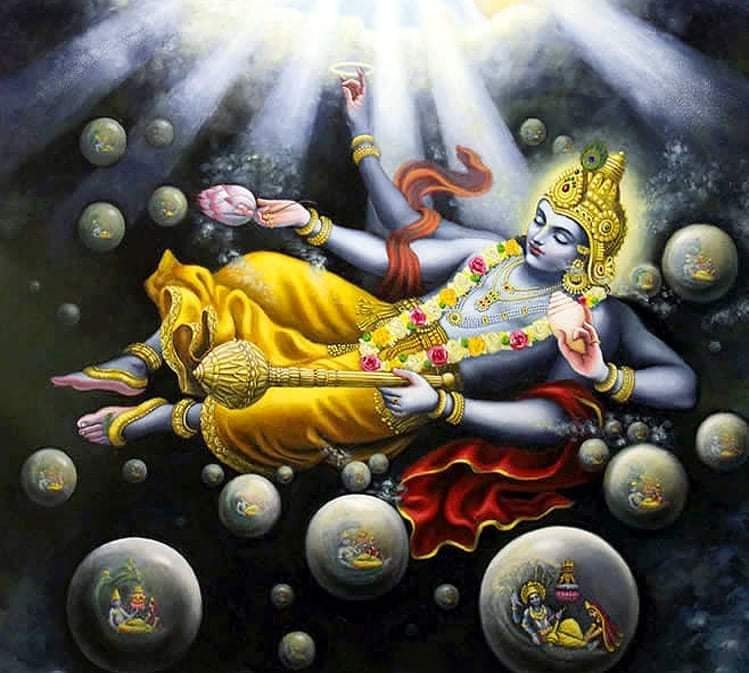
Maha Vishnu and the billions of massive universes coming from His body.
The material dimension of innumerable planets within innumerable universes regularly undergoes creation and then dissolution. At dissolution, the entire energy composing the material dimension is withdrawn within the Supreme Person, to be released when creation again takes place. The entire material dimension is an insignificant emanation of the Lord’s inferior energy and is controlled and destroyed by His energy called kala or time.
The purpose for creation of the material dimension is to allow freedom of choice to the eternal living being to live apart from God outside of His kingdom if he so desires. Each living being within the spiritual dimension experiences full happiness in his relationship with the Supreme Person and in his relationships with all other fellow living beings there. How is it possible that living beings in the perfection of existence could possibly desire something else?
Freedom to love and serve God is not forced upon the living being, nor is that freedom to choose an imperfection. Actual loving service and devotion for the Supreme Lord must be completely free from any doubt or tinge of indecision. If one feels the slightest desire to not serve, then immediately that desire is fulfilled by birth and incarceration in the prison of the material dimension. Now, I can falsely “do what I want.”
It is like a child playing nicely in a group of other kids who then wants to do something else and will disrupt the whole group to try to get his way. So, he leaves to go do his thing, and he realizes it is not so fun without everyone else. The material dimension is set up so that the living being realizes that he has left his actual happiness and then wants to return.
In this material dimension, the envious living being can attempt to be the controller, the owner, the enjoyer, competing with all other beings who want to take God’s position of being the Supreme Enjoyer, the Supreme Controller, the Supreme Protector, the Supreme Lover, the Supreme Master, etc.
The wayward and rebellious living beings have unlimited desires to try to fulfill and must struggle so hard just to maintain the material body, family, friends, occupation, security, and well-being. At the same time, weighed down by karmic reaction, suffering caused by other living beings, natural disturbances, mental dilemmas, and so many other problems, one’s body ages as one faces death on the horizon. Once again, eternal time exacts its toll.
I am an eternal living being who has freely made the sad decision to leave behind all that is good, all that is eternal, all that is fulfilling, and all that is perfect. My rehabilitation takes place in the dimension created for that purpose, the perfectly created illusory, temporary, dark dungeon of material existence with no escape possible until I turn to my Supreme Friend and ask for release.
Within the material dimension, I am covered by ignorance that blocks any recollection of my eternal existence, ignorance that makes me believe I can find happiness here, ignorance that masks the suffering of temporary life in a temporary body, ignorance that I am the cause of all my suffering, ignorance that cheats me from understanding why the material dimension exists, and ignorance that hides all other truth from me. I have amnesia caused by ignorance and I do not even know who I am or why I am here.
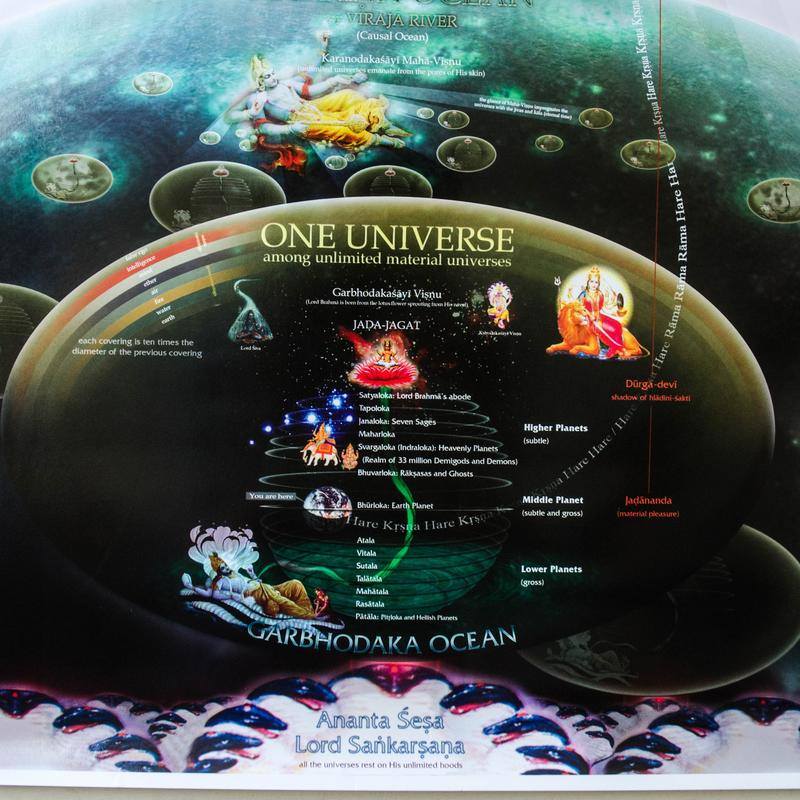
There are 14 Planets in each universe
I am perpetually trapped within this place of repeated birth and death and may believe I have a “good” life, but death is always lurking, waiting to take it all away. Anxiety shadows me throughout my travels, from the upper planetary systems to the lower, as I rotate on the wheel of birth and death, always interrupting my quest for pleasure and peace.
As I grow weary of repeated failures life after life, if I am fortunate, I come in contact with transcendental sound and knowledge which is the lifeline to pull me from the ocean of material suffering. My intelligence becomes purified, and I realize that I am an eternal person imprisoned in a temporary decaying dimension of time, of birth, disease, old age, and death.
The transcendental process of Sadhana Bhakti becomes my parole from this dark collection of material universes and my complete freedom comes with the perfection of Bhakti Yoga.
Sahadeva Das is an initiated disciple of Jagad Guru Siddhaswarupananda Paramahamsa who comes in a long line of bona fide yoga spiritual masters. Sahadeva Das considers it his great fortune in life to have heard and learned from a self-realized soul and is humbly attempting to pass on what he has received.
Spiritual emancipation begins with self-realization: Who am I? Why do I exist? What is my purpose? Why am I controlled by forces outside of me? Why do I suffer? Why is my happiness fleeting and temporary? Why do I have to struggle for existence? Why do I face death?
Why do I ignore all these questions or fail to find honest answers?
Death always finds every living being regardless of their social position, level of intelligence, power, wealth, determination, or species. Every event, emotion, relationship, fear, activity…experienced between birth and death is seen and known.
What is seen at death and after? Are there answers that are absolute and unchangeable across time, regardless of changing civilizations, religions, and philosophies?
The sun rises and sets, unchanging and constant.
Absolute knowledge is unchanging and constant, now, a million years in the past, a million years in the future, in every universe and planet, in all circumstances and for every unique living being.
Natural and Spiritual laws can be ignored, defied, and broken, but never defeated as the resulting reactions are invincible and always carried out.
Wars, hurricanes, earthquakes, famine, disease, and all calamities and sufferings are examples of resultant reactions from breaking these infallible laws which govern the material dimension.
The opposite is also true: prosperity, peace, beneficial and regulated climate, abundance, happiness, are examples of resultant reactions of knowing and following the natural and spiritual laws that govern the universe.
Beyond the good and bad results, the pain and pleasure, the birth and death, the order and chaos, the heavenly and hellish conditions, the unrelenting control of cruel time, exists a place completely devoid of all these material conditions of duality and suffering.
The only requirement to enable anyone to come to the platform of perfect understanding is a sincere desire to humbly receive this transcendental knowledge descending from that eternal place where the only law is perfect love.
The human form of life is suitable for inquiring into and understanding the science of Bhakti Yoga which breaks the bonds of material reaction and results in the perfection of existence.
Trapped on the insurmountable wheel of birth and death, no solutions are possible to be found within the speculative minds of all the intellectuals, philosophers, and “religionists”, who for all time have struggled and failed to understand Spiritual Truth as it is.
One who has seen the truth enlightens those sincere living beings who are genuine seekers of truth, releasing them from the temporary illusions of an unending cycle of birth ending in death, and mistakenly called “life”.
Anywhere and everywhere on this planet earth, among individuals, families, cities, states, countries, and societies, regardless of the species, controllers or dominators exert their power. Similarly, universal controllers manage all the forces acting on the planetary systems within the confined universe or prison of birth and death.
Every eternal living being in the material universe is imprisoned in a material cell (the body, mind, and intelligence) and is allowed to move about the prison (the material world), ironically feeling “free”, not realizing that the death sentence has been pronounced and is simply waiting to be carried out. In the penitentiary this same situation places the person on “death row”.
Nobody in their right mind desires to spend their life in prison, yet every living being is trying to enjoy their endless imprisonment in the material world by incessantly attempting to find happiness where no real happiness can be found. Surviving incarceration life after life does not equal true existence.
The solution revealed by those who are enlightened takes root in the heart of the living being when received by aural reception. This pure transmission of transcendental knowledge emanates from one who has themself received it from the pure source.
The conditions of our true and actual existence are eternality, full knowledge, and ever- increasing spiritual happiness resulting from the most intense, satisfying perfection of our loving relationship of service to the most perfectly attractive Supreme Being.
To begin and culminate this journey of uncovering one’s original identity, position, and function, the path of Bhakti Yoga stands supreme. When faithfully and sincerely followed, Bhakti Yoga transports one from enduring the suffering of material life to the world of unending and ever expanding spiritually perfect relationships.
These eternal relationships unfold like the petals of the Lotus flower, blooming with unlimited varieties of intensely pleasurable activities in the mood of servant, friend, parent, or lover with the Supreme Attractive Person.
In stark contrast, the embodied living being tastes disappointment, frustration, anxiety, and anger while trapped in illusory temporary relationships of this world. Each of these relationships, built over a lifetime, generates uncountable attachments which cause immense suffering as the living being is cruelly forced from the useless body at the time of death.
This false position of identifying oneself with a temporary body made of matter reduces the pure and eternal living being to a state of ignorance referred to as “false ego”.
As the sun rises, crosses the sky, and then sets; similarly, the living being enters the body and is born, crosses the expanse of life, and then leaves the body at death.
What then is the body? The body can be understood to be a machine made of matter, energized by the eternal living being and utilized to interact with other embodied living beings in a counterfeit attempt to imitate the activities of the spiritual dimension.
All such attempts end in complete failure because matter and material activities are temporary by nature. The living being is eternal by nature and meant to exist in the eternal spiritual world complete with all varieties of spiritual forms, relationships, and activities.
When inhabiting a material form the living being endeavors to enjoy life. Having forgotten completely his spiritual form and identity, the living being mistakes the machine made of matter (the body) as the most important person in his life (me!)
Very few persons approach the Truth with an honest desire and determination to openly receive the greatest gift of love that can be given: to be raised to the transcendental platform of eternality, complete knowledge, and perfect unending ever-expanding love and happiness in our uniquely perfect relationship with the Perfect Supreme Person. This is the true goal of life, achieved through the process of Bhakti Yoga.
Sahadeva das is an initiated disciple of Jagad Guru Siddhaswarupananda Paramahamsa who comes in a long line of bona fide yoga spiritual masters. Sahadeva das considers it his great fortune in life to have heard and learned from a self-realized soul and is humbly attempting to pass on what he has received.
Many have struggled to ascend Mt. Everest, some have succeeded, and some have failed. They all have a strong drive to conquer Mt. Everest and some live and some die in the attempt. Training, climbing techniques, physical conditioning, desire and determination, proper equipment, are all factors of a successful ascent of the mountain peak. What are the unknown factors beyond anyone’s control which ultimately decide the climber’s fate?
Throughout the ages, man has endeavored to reach the summit of spiritual perfection in one of two methods: by the ascending or the descending process for attaining spiritual truth.
The ascending process relies on a self-centered approach that I can, and I will conquer the mountain of supreme knowledge and truth by my personal prowess. This effort mimics the climber of Mt. Everest.
The descending process is one of surrender and dependence on receiving all that I need by the mercy of God.
Ultimately, both are subject to the will of the Supreme Person. The expert climber may be defeated by bad weather, equipment failures, avalanches, sickness, etc., all of which are beyond his control and proof that there is a higher power than himself.
The highest spiritual perfection one can achieve through the ascending process is to approach the impersonal brahman. Actual entrance into the brahmajyoti requires the permission of the Supreme Lord. The success achieved by the ascending process is the lowest level of spiritual realization and is shunned by the spiritualists who desire to attain complete and perfect realization of the Supreme Person.
For eons, spiritual seekers have spent lifetimes failing to climb their way into the spiritual dimension by their own efforts. Not understanding that the Supreme Absolute is a person, they try to force themselves into his presence. God is the Supreme Person who alone decides to allow the living being to approach Him or to keep him away.
Giving up all arrogance, pride, and faith in one’s own abilities, the sincere seeker of truth, can, in full humility, approach the Supreme Lord for His help. Receiving his transcendental mercy in the form of transcendental sound, scripture, saintly persons, and the lord in the heart, one can achieve perfection by receiving God’s help descending from the spiritual dimension.
The descending process, therefore, depends on me giving up all my efforts to figure things out and to simply receive perfect guidance, knowledge, and assistance from the Supreme Friend who desires my return to the spiritual world.
Bhakti yoga is the perfect linking process to the Supreme Lord and the perfection of the descending process to achieve the goal of life. There are no material requirements to achieve the pinnacle of perfection. I only need to sincerely approach God and ask for His help, and He will respond.
Whatever understanding I have of God is sufficient for me to approach Him through sincere communication of any type, silently within my mind, out loud, by writing, etc. He is present everywhere and in my heart. He always knows my thoughts, desires, secrets, and is the witness of all my activities.
He is my best friend and eternal well-wisher Who arranges my life, and places opportunities before me, to progress on the path of self-realization and God-realization according to my sincerity and determination.
If my efforts for self-realization and God-realization fall under the category of the ascending process, then I am simply in the illusion that I am powerful enough to approach God and come into His presence. This attitude is simply material arrogance and blocks my entrance into the spiritual dimension.
The living being who cultivates spiritual humility by the purifying process of Bhakti Yoga, will realize that he is completely powerless to approach the Absolute Truth on his own. In this consciousness one can then receive spiritual knowledge, understanding, and remembrance to develop attraction and then love for God. God alone decides, if and when, to fully reveal Himself to the sincere and humble seeker.
This is the descending spiritual process which is a process of surrender to the Supreme Person and the reception of His mercy, grace, and love.
By this descending process only, I return to my original position as the loving eternal associate of the Supreme Person.
Sahadeva Das is an initiated disciple of Jagad Guru Siddhaswarupananda Paramahamsa who comes in a long line of bona fide yoga spiritual masters. Sahadeva Das considers it his great fortune in life to have heard and learned from a self-realized soul and is humbly attempting to pass on what he has received.
The birth of a child is a celebration, a welcoming of a newcomer into a family. But with every birth must come death. We all know this to be true, although we prefer not to think about it. However, we may not be aware that every death is followed by a birth. The Bhagavad-Gita describes this truth:
For one who has taken his birth, death is certain; and for one who is dead, birth is certain.
Bhagavad-Gita 2:27
Who is the one, referred to here, whose birth and death is certain? The answer is the living being, or spirit soul. The soul itself does not actually die, so the birth and death being described are only the birth and death of the body.
For the soul there is never birth nor death. Nor, having once been, does he ever cease to be. He is unborn, eternal, ever-existing, undying, and primeval. He is not slain when the body is slain.
Bhagavad-Gita 2:20
Even though I experience the birth and death of the body I am in, I never die, and I am never born. I am the living being within the body. My body is born, but I existed before that birth. In fact, there has never been a time when I did not exist. I came into the body at conception, and I will leave it at death. I am eternal and always a person, whether or not I am in a material body.
As a person puts on new garments, giving up old ones, similarly, the soul accepts new material bodies, giving up the old and useless ones.
Bhagavad-Gita 2:22
This cycle of repeated birth, death and reincarnation, is recognized in many traditions and is understood as being a painful experience, not something to celebrate.
The soul changes bodies as a person changes garments.
Can I become free from the cycle of birth and death? According to Vedic literature, this is not only possible but is the goal of human life. Indeed, it is only while I am in a human body that I can inquire into these subjects and can learn how to end the cycle of birth and death.
What happens when I am freed from having to accept and give up material bodies? Some people think that if I don’t have a material body, then I must be some kind of formless spirit. Their idea is that there is no form, variety, or activity in the spiritual world. But, according to the Vedas, this is not the case.
The spiritual world is not void, and I have an eternal spiritual form, even though I am currently unaware of it. I am meant to live in the spiritual world experiencing spiritual activities, spiritual happiness, spiritual emotions, and spiritual relationships.
There is a practice called Bhakti Yoga which is the most effective and efficient means of ending the cycle of birth and death. The Vedas are full of histories of people who became self-realized and free from birth and death by following the path of Bhakti Yoga.
That is the way of the spiritual and godly life, after attaining which a man is not bewildered. Being so situated, even at the hour of death, one can enter into the kingdom of God.
Bhagavad-Gita 2:72
About the Author:
Sahadeva Das is an initiated disciple of Jagad Guru Siddhaswarupananda Paramahamsa who comes in a long line of bona fide yoga spiritual masters. Sahadeva Das considers it his great fortune in life to have heard and learned from a self-realized soul and is humbly attempting to pass on what he has received.
Picture this. You have not been feeling well for the past month, and you decide to go for a check-up. Your doctor tells you that you have a fast-moving fatal blood cancer, and you only have a month to live. How would you feel? Would you be in shock or denial, or angry? At any time, any one of us could get bad news from a doctor, telling us that we have only a short time to live.
Most likely your mind would be racing as you’re overcome with fear and grief, for yourself, for your family, and for everything you stand to lose. “Why me?” you might ask. “This cannot be happening.” Panic and lamentation would set in as you lose all composure and realize, “I am not prepared for death.”
Do any of us know what happens after death or how to prepare for the inevitable end that awaits us?
For one who has taken his birth, death is certain; and for one who is dead, birth is certain.
Bhagavad-Gita 2:20
Nowhere else will you find such a clear explanation of death as in the yoga scripture, the Bhagavad Gita. While death is a reality, we will all face, we are not taught what it actually is and how to prepare for it. However, with proper knowledge and preparation, we can avoid the pain, suffering, and fear that usually accompanies the moment of death.
As the embodied soul continually passes in this body, from boyhood to youth to old age, the soul similarly passes into another body at death. The self-realized soul is not bewildered by such a change.
Bhagavad-Gita 2:13
When the body is no longer able to function, due to an accident, disease, old age, or some other factor, the embodied soul must leave. Those who see a dead body and grieve the death of the person they loved are misidentifying the dead body as the person who has left. But the person they loved is an eternal being and can never die. They continue to exist after they leave the body.
The person leaving the body also suffers greatly due to the illusion that they are dying. But it is only their body that is dying. If we identify our body as ourselves, and we do not know that we are an eternal living being, death is a very fearful experience.
As a person puts on new garments, giving up old ones, similarly, the soul accepts new material bodies, giving up the old and useless ones.
Bhagavad-Gita 2:22
In order to leave the body without grief and fear, we must become self-realized. And what is self-realization? It is understanding that we are an eternal living being, a spark of God, a child of God, away from our spiritual home, and temporarily within a material body. The body is not our true identity.
It is said that the soul is invisible, inconceivable, immutable, and unchangeable. Knowing this, you should not grieve for the body.
Bhagavad-Gita 2:25
We are destined for rebirth in another material body unless we learn how to break free from the cycle of repeated birth and death. Liberation from this cycle is possible when we realize we are eternally connected to the Supreme Soul, in a loving relationship with Him.
If you were told that in one week you will have to leave everything behind and move to a foreign country, with no chance of return, would you prepare?
Moment by moment, the lifespan of your body is being reduced. Your body is going to die. Are you prepared to leave and to face what comes next? According to the yoga teachings, this life is meant for self-realization and for ending the cycle of birth and death. The practice of bhakti yoga offers a direct and practical path to self-realization – a path that is available to everyone.
Sahadeva Das is an initiated disciple of Jagad Guru Siddhaswarupananda Paramahamsa who comes in a long line of bona fide yoga spiritual masters. Sahadeva Das considers it his great fortune in life to have heard and learned from a self-realized soul and is humbly attempting to pass on what he has received.
All bodies of all living species within the universe have life due to the eternal living being present within that particular body. From the controlling administrators of the universe down to the smallest germ, all are eternal living beings trapped within that material body.
Life after life, the false ego, the modes of material nature, and the control of the illusory energy or Maya, relentlessly condition the living being. This conditioning forces one to accept the material body as himself. I forget my true identity as an eternal person, while temporarily incarcerated within a material body, within a material universe.
Consider this situation. I am an eternal person from the eternal spiritual world, full of knowledge and happiness. Transgressing the singular law of spiritual love due to envy, I have been thrown into the material universe with absolute amnesia of my eternal identity and life.
I am now covered with the conditioning or ignorance that whatever body I am forced to enter I fully accept as “myself.” My underlying desire or motivation is to be lord and controller. I have been placed in the material universe to imitate the Supreme Lord and Controller who I have turned my back on.
From this point, being completely illusioned and under the control of ignorance, I accept body after body, life after life. Driven by my conditioned consciousness, I am struggling for existence and the pursuit of happiness in a place where invincible laws and energies have been enacted to perpetually defeat me.
Endlessly searching for this illusory happiness within the world of matter, I am cheated because I can only be satisfied by spiritual happiness which exists outside of the material universe. Material energy or the material world is masquerading as my original spiritual home.
I am an eternal spiritual person with a spiritual body and a spiritual home complete with loving spiritual relationships. I do not need a fake material body, fake material relationships, fake material enjoyments, and the fake carnival of material existence.
Everyone is simply being lied to and cheated, and in turn, lying to and cheating others.
If I accept a lie as the truth, not realizing it is a lie, then I have no problem passing that lie onto others. All cultures and societies within the material universe accept the underlying lie “I am this material body.”
Covered and impelled in all activities by this untruth, the embodied living being wanders throughout the material universe from body to body, planet to planet. There was a song that defines this fruitless wandering: “I still haven’t found what I am looking for,” and another “I can’t get no satisfaction.”
“I am this material body” is the first lie covering the living being’s awareness or consciousness as he descends into the material universe. This lie is referred to as false ego and makes it possible for the living being to repeatedly cycle through the wheel of birth and death because material life seems to be the purpose of existence. It most definitely is not.
In the condition of being dominated by false ego, the living being is also manipulated and controlled by the illusory energy of the Supreme Lord known as Maya.
Each conditioned living being is further handicapped by four defects: I make mistakes. I am illusioned. I have imperfect senses. I have a tendency to cheat.
I am also forced to accept suffering caused by other living beings, my own mind and body, and natural disturbances and disasters.
The path of destruction of the conditioned soul’s intelligence due to dictation of the senses and mind is portrayed. [Image Credit: Asitis.com]
Maya presents endless, irresistible, alluring, material attachments, and seductive plans for enjoyment that promise fulfillment, satisfaction, and happiness. Attracted, attached, and bewildered, the living being is again and again betrayed and ends up lonely, frustrated, angry, and helpless against this onslaught of Maya.
After countless lifetimes cheated by Maya, the fortunate living being will begin to question why happiness is so elusive and suffering so pervasive, and then will seek help. If he is most fortunate, he will be led to the truth which begins with the realization that I am not this material mind or body.
Dissolving the conditioning of millions of lifetimes of false ego, material habits, attachments, and the abusive illusion from Maya is only possible by sincerely embracing and following the transcendentally purifying path of Bhakti Yoga.
On this path, I receive the mercy and the unconditional love of the Supreme Lord as soon as I open my heart to Him. The control of Maya is gradually withdrawn as I surrender to and follow the instructions of the Lord and I taste spiritual love which I have always been craving and searching for.
Further progress dissolves the false ego and I become immune to and free from all material conditioning. Ultimately, I am given the realization of my original identity and form and am reinstated to the perfection of my eternal position of loving devotional service to the Supreme Lord.
I have returned to the spiritual world, and whether or not I am still temporarily within a physical body, I will never again be covered by false ego and be forced to assume another material body.
Sahadeva Das is an initiated disciple of Jagad Guru Siddhaswarupananda Paramahamsa who comes in a long line of bona fide yoga spiritual masters. Sahadeva Das considers it his great fortune in life to have heard and learned from a self-realized soul and is humbly attempting to pass on what he has received.
There are some important questions we should all ask at some point. Who am I? What is the purpose of life? Does God exist? What happens at death? Where did I come from? Why is there suffering?
But where can I find definitive answers to these questions?
Google has become the default source of information for most people despite the overwhelming amount of material that comes up in answers to their searches. But so much of the information is incomplete or misleading. If I Google “Who am I?” I got 65 million results. “The purpose of life” returns over 330 million results, while a search on “God” or “death” returns over 2 billion results. I could give up and say that ignorance is bliss, but I want to know the truth.
Maybe the answer is somewhere in the world of Google, hidden among the billions of results. But if I do not know the truth, how will I recognize it, even if I had time to read them all? I may accept that real knowledge and truth do exist, but how do I go about accessing them? Where do I go? Who do I ask?
In the Bhagavad-Gita we are told:
Just try to learn the truth by approaching a spiritual master. Inquire from him submissively and render service unto him. The self-realized soul can impart knowledge unto you because he has seen the truth.
Bhagavad-Gita 4:34
How do I find such a self-realized soul? It is said, “By the grace of God, one gets guru, and by the grace of guru one gets God.” If I sincerely approach the Supreme Person and ask for His help, He will bring me into contact with His transcendental representative.
I experienced this truth in my own life. In 1971, I was living on the bay fronting Sausalito, on a thirty-five-foot steel lifeboat that had been converted into a houseboat. It was a very cold winter, and the boat was like an icebox. I had left behind college and my four-year scholarship and was searching for the Absolute Truth.
One night, I approached God in sincere prayer, asking Him to lead me to someone who knew Him. Within three months, I met Jagad Guru Siddhaswarupananda, a self-realized soul who comes in a long line of bonafide spiritual masters.
I can approach God through sincere communication of any type, silently within my mind, out loud, or in writing. He is present everywhere, including in my own heart. He knows my thoughts, desires, and secrets, and is the witness of all my activities. I do not even have to be convinced that He is real. I can simply ask, “Please let me know You.”
The Supreme Person is my best friend and eternal well-wisher and is happy to answer my sincere plea. He arranges my life and places opportunities before me, so I can progress on the path of self-realization and God-realization if that is what I want. The truth then will appear to me, in what may seem like random events, such as my meeting with Jagad Guru all those years ago. I will also be given the ability to recognize the truth as it appears.
The Supreme Lord says, “Out of compassion for them, I, dwelling in their hearts, destroy with the shining lamp of knowledge, the darkness born of ignorance.
Sahadeva das is an initiated disciple of Jagad Guru Siddhaswarupananda who comes in a long line of bona fide yoga spiritual masters. Sahadeva das considers it his great fortune in life to have heard and learned from a self-realized soul and is humbly attempting to pass on what he has received.

































 LetItGrow.org