Cultivating Humility: Key to a Harmonious Life

Humility is often hailed as one of the most crucial virtues for success and personal growth. Humility is not about diminishing oneself or lacking confidence but about shifting our focus away from self-centeredness to a more respectful and open-minded approach towards others.

In essence, humility involves showing respect for others, being open to their perspectives, and allowing space for their experiences without passing judgment.

By nurturing humility, you invite positive growth in every important area of your life. Gradually you will experience a peaceful, satisfying and harmonious life for yourself and others around you.

Let’s explore this further…

Lack of Humility Breeds Personal & Societal Disturbance

In general, when we place ourselves above others due to some unknown tendency, we hinder our own progress. It gradually breeds arrogance that may act as a blindfold, preventing us from recognizing our shortcomings, while shifting our focus outward. This mindset prevents our personal growth and disrupts all aspects of life—whether in relationships, at work, or in our personal lives. Without humility, chaos and disorder are likely to follow.

History is filled with many instances where the arrogance and lack of humility of so-called big leaders led to the downfall of their entire empires and dynasties. Consequently, their subjects suffered as well.

Consider if a husband might view himself as superior to his wife, or a student might believe they are more intelligent than their teacher. An employee might see themselves as more skilled & smarter than their boss or colleagues. Boys might believe they are superior to girls, the wealthy might feel they are above the poor, or one race might regard itself as more privileged than another. A beautiful woman might look down on those she thinks less attractive, and a strong man might feel superior to the physically weak ones.

This belief in one’s own superiority often results in disrupted relationships, racism, exploitation, and even conflict and war. Even if someone truly excels, they should still treat others with all respect.

Humility Plays A Vital Role For Success

A skilled individual may surpass others with their talents and abilities, gaining recognition and admiration. However, a humble person not only earns respect but also wins people’s hearts. This creates a deeper connection and builds trust, empathy, and sincerity, which are essential for lasting success in any field of life, as it fosters meaningful relationships and genuine support from those around them.

Let’s see how practicing humility can help us in our daily lives.

1. Strengthens Relationships

Humility is crucial for fostering meaningful relationships. When we embrace humility, we prioritize the needs, feelings, and perspectives of others, becoming more understanding rather than confrontational.

Instead of focusing on finding faults, we begin to empathize with others’ situations, leading to mutual respect and trust. Humility also prevents us from passing quick judgments, encouraging open-minded and meaningful communication.

Moreover, it helps us recognize our own flaws and accept the imperfections in others, laying the foundation for deep, harmonious and lasting connections.

2. Fosters an Open Mindset

When we embrace humility, we acknowledge that we don’t have all the answers. This opens the door to a learning mindset, allowing us to actively listen to others and explore new perspectives.

Humility encourages us to become lifelong learners, continuously improving without the barrier of pride or the illusion of already knowing it all. By staying open to new ideas, we grow and evolve in ways that would otherwise be impossible.

3. Encourages Self-Reflection & Growth

Humility allows us to acknowledge our flaws with clear insights. Free from the blinding effects of arrogance, we can recognize our mistakes and take constructive steps toward improvement. This openness makes it easier to handle criticism/feedback.

By accepting and understanding our imperfections, we can actively work on them, fostering personal growth and continuous development throughout life.

4. Enhances Leadership

A humble leader is more likely to earn the loyalty, cooperation, and respect of their team. Humility in leadership means appreciating the efforts of everyone, being open to feedback, and focusing on the team’s success instead of seeking personal praise. This creates a positive and welcoming environment where everyone feels valued and motivated to do their best.

5. Develops Empathy

Humility and empathy are closely connected. A humble person is better able to understand and relate to what others are feeling, which helps them show more kindness and care. When we let go of our ego and stop focusing only on ourselves, we can truly connect with others, see their challenges, and offer support in ways that really matter.

Humility allows us to put ourselves in someone else’s shoes, making it easier to be compassionate and helpful.

6. Promotes Forgiveness

Humility makes it easier for us to forgive others and ask for forgiveness when we’ve made mistakes. It helps us let go of grudges and avoid conflicts caused by pride. By being humble, we create peace and emotional healing, both for ourselves and in our relationships.

A humble attitude allows us to stop worrying about being right all the time, leading to more harmony and understanding with others.

7. Keeps Us Grounded in Success and Failure

Humility helps us stay balanced, no matter what we go through. When we succeed, it stops us from becoming arrogant or feeling like we deserve special treatment, which can harm our relationships and hold back future progress.

In times of failure, humility helps us stay strong because it allows us to admit our mistakes, learn from them, and move forward without feeling hopeless or blaming others.

8. Leads to Inner Peace

One of the most valuable benefits of humility is the inner peace it brings. Humility helps us stop seeking constant approval and praise from others and let go of the need to control everything or everyone around us. By freeing ourselves from the weight of pride and the pressure to always prove our worth, we can significantly reduce stress and anxiety.

As we move away from ego-driven concerns, we begin to feel more satisfied and calm inside, no matter what is happening around us. This inner peace allows us to live more serenely, without being affected by outside situations or people’s opinions.

Humility is an Absolute Necessity In Spiritual Life

Lord Sri Chaitanya Mahaprabhu, the great apostle of love of Godhead and the preacher of congregational chanting (sankirtan movement), has emphasized humility as essential for advancing in spiritual life.

He has written prayers of eight verses that express devotion to the Supreme Lord, Sri Krishna.

In the third verse, He writes:

“One should chant the holy name of the Lord in a humble state of mind, thinking oneself lower than the straw in the street; one should be more tolerant than a tree, devoid of all sense of false prestige and should be ready to offer all respect to others. In such a state of mind one can chant the holy name of the Lord constantly.”

World-renowned yoga spiritual master, Jagad Guru Siddhaswarupananda Paramahamsa, explains this verse of Lord Chaitanya:

“It is not just a recommendation that one should chant the holy name of the Lord in a humble state of mind, but it is an absolute necessity for success. Because if you do not cultivate this humility, then surely you will be in a situation where you are passing judgment. That is an offence.”

Finding faults in other devotees & God is considered the biggest offence that stunts our spiritual growth. When we become judges and start finding faults in others, it becomes impossible for us to develop a real taste for chanting the Holy Names of God, which is the only way to advance in spiritual realization in this age.

Lord Sri Chaitanya Mahaprabhu’s emphasis on humility in spiritual practice underscores its universal importance. By aligning our mindset with these teachings, we not only enhance our spiritual progress but also cultivate a more compassionate and respectful approach to others in all areas of life.

If you liked this article, please share it with your family and friends. I would love to see your reactions in the comment section.

Thank you for your time.
New to Meditation? Discover the Easiest Method in 10 Minutes

Among all spiritual meditation methods, mantra meditation stands out as both the simplest and most sublime.

So, what is mantra meditation, why is it so sublime and what are its variations?

Let’s dive in.

What is Mantra Meditation?

Let’s break down the term:

Mantra” is a sacred sound vibration originating from the Spiritual realm. While there are many mantras, those directly connected to the Names of God, like “Gopala Govinda Rama,” are considered Supreme Mantras.

Meditation” is the practice of concentrating one’s mind and consciousness on a specific object or entity.

So, Mantra Meditation means focusing your mind on the spiritual sound vibration or the Holy Names of God.

Why it is the Most Sublime Method of Meditation?

The goal of all meditation methods is self-realization & make spiritual progress. But most of the known meditation methods require resources or conditions that are very challenging for an individual. So, many can’t even begin or sustain their meditation practice.

Mantra meditation simplifies this since you just need to chant and hear the Holy Names of God. And by following this simple process you will be gradually connected to the spiritual realm.

By focusing on the Transcendental Sound (Mantras), you make direct contact with the Supreme Soul.

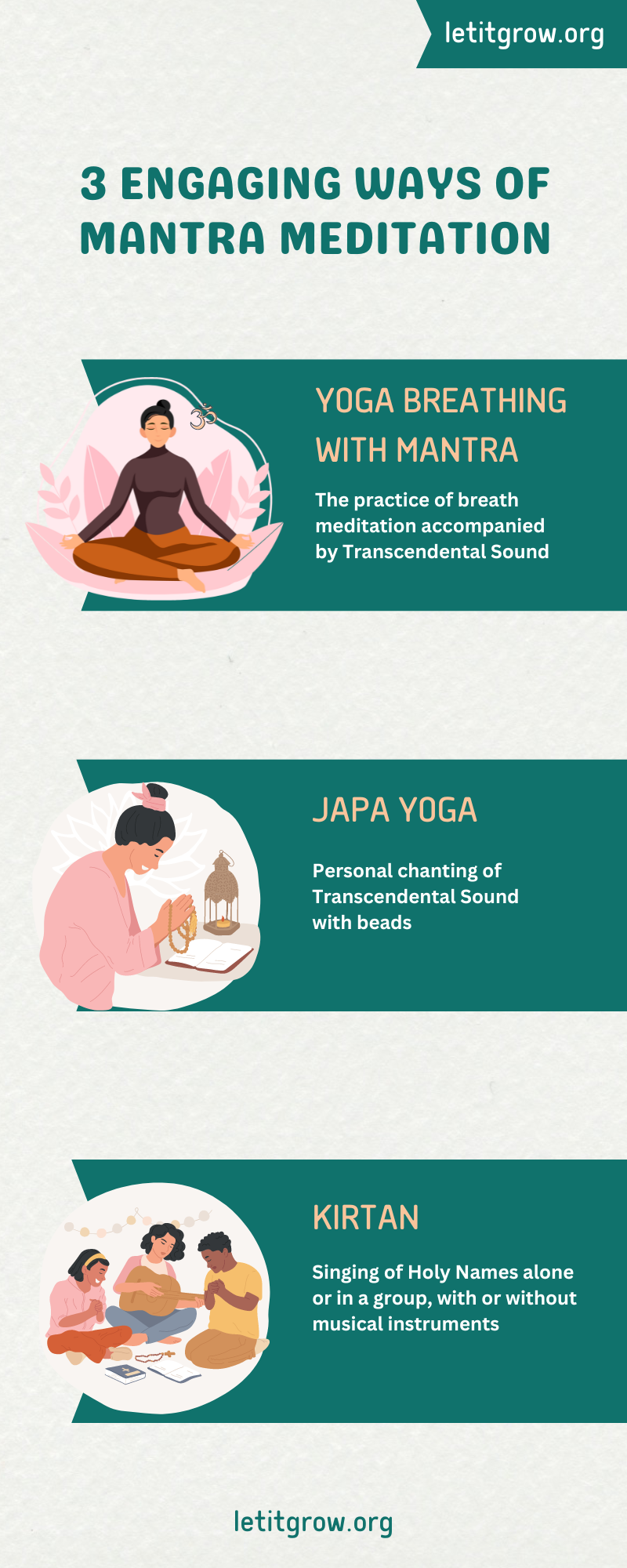
3 Engaging Processes of Mantra Meditation

A. Yoga Breathing With Mantra – It involves combining breath meditation with Transcendental Sound.

As you practice, you focus on your breath with each inhale and exhale while chanting the mantra – Gauranga*. Mentally repeat the mantra during each inhale, and chant it out loud with each exhale.
(* refers to Lord Gauranga- an incarnation of Supreme Person or God)

Want to give this a try?

Explore more about Yoga Breathing in this page!

B. Japa Yoga – Also known as Japa meditation, is a form of mantra meditation that involves the repetitive chanting of mantras while using a string of beads. This is normally practiced alone in a less crowded space.

A person chants the mantra (names of God), repeatedly while trying to maintain a focused and mindful state. While chanting the mantra they roll their fingers on each bead.

Learn more about Japa Meditation.

C. Kirtan – Singing or chanting the Transcendental Sound individually or in a group, is also a great way of mantra meditation. We can even use musical instruments.

In fact this method is highly recommended for this age in the ancient vedic scriptures.

Curious about Kirtan? Watch this video of Jagad Guru Siddhaswarupananda Paramahamsa to learn more.


No matter which method you choose, the goal is to connect with the Supreme Soul by chanting the Holy Names. This connection allows you to experience inner peace and spiritual happiness.

So, which method are you excited to try? Please share your thoughts and experiences in the comments—I’d love to hear which method resonates with you!

Thank you for giving your precious time.

Learn more about mantra meditation.

Immunity from Birth & Death

Spiritual emancipation begins with self-realization: Who am I? Why do I exist? What is my purpose? Why am I controlled by forces outside of me? Why do I suffer? Why is my happiness fleeting and temporary? Why do I have to struggle for existence? Why do I face death?  

Why do I ignore all these questions or fail to find honest answers? 

Death always finds every living being regardless of their social position, level of intelligence, power, wealth, determination, or species. Every event, emotion, relationship, fear, activity…experienced between birth and death is seen and known. 

What is seen at death and after? Are there answers that are absolute and unchangeable across time, regardless of changing civilizations, religions, and philosophies? 

The sun rises and sets, unchanging and constant. 

Absolute knowledge is unchanging and constant, now, a million years in the past, a million years in the future, in every universe and planet, in all circumstances and for every unique living being. 

Natural and Spiritual laws can be ignored, defied, and broken, but never defeated as the resulting reactions are invincible and always carried out. 

Wars, hurricanes, earthquakes, famine, disease, and all calamities and sufferings are examples of resultant reactions from breaking these infallible laws which govern the material dimension. 

The opposite is also true: prosperity, peace, beneficial and regulated climate, abundance, happiness, are examples of resultant reactions of knowing and following the natural and spiritual laws that govern the universe. 

Beyond the good and bad results, the pain and pleasure, the birth and death, the order and chaos, the heavenly and hellish conditions, the unrelenting control of cruel time, exists a place completely devoid of all these material conditions of duality and suffering. 

The only requirement to enable anyone to come to the platform of perfect understanding is a sincere desire to humbly receive this transcendental knowledge descending from that eternal place where the only law is perfect love

The human form of life is suitable for inquiring into and understanding the science of Bhakti Yoga which breaks the bonds of material reaction and results in the perfection of existence. 

Person caged in a cell

Trapped on the insurmountable wheel of birth and death, no solutions are possible to be found within the speculative minds of all the intellectuals, philosophers, and “religionists”, who for all time have struggled and failed to understand Spiritual Truth as it is. 

One who has seen the truth enlightens those sincere living beings who are genuine seekers of truth, releasing them from the temporary illusions of an unending cycle of birth ending in death, and mistakenly called “life”.

Anywhere and everywhere on this planet earth, among individuals, families, cities, states, countries, and societies, regardless of the species, controllers or dominators exert their power. Similarly, universal controllers manage all the forces acting on the planetary systems within the confined universe or prison of birth and death. 

Every eternal living being in the material universe is imprisoned in a material cell (the body, mind, and intelligence) and is allowed to move about the prison (the material world), ironically feeling “free”, not realizing that the death sentence has been pronounced and is simply waiting to be carried out. In the penitentiary this same situation places the person on “death row”. 

Nobody in their right mind desires to spend their life in prison, yet every living being is trying to enjoy their endless imprisonment in the material world by incessantly attempting to find happiness where no real happiness can be found. Surviving incarceration life after life does not equal true existence. 

The solution revealed by those who are enlightened takes root in the heart of the living being when received by aural reception. This pure transmission of transcendental knowledge emanates from one who has themself received it from the pure source.  

The conditions of our true and actual existence are eternality, full knowledge, and ever- increasing spiritual happiness resulting from the most intense, satisfying perfection of our loving relationship of service to the most perfectly attractive Supreme Being. 

To begin and culminate this journey of uncovering one’s original identity, position, and function, the path of Bhakti Yoga stands supreme. When faithfully and sincerely followed, Bhakti Yoga transports one from enduring the suffering of material life to the world of unending and ever expanding spiritually perfect relationships.  

These eternal relationships unfold like the petals of the Lotus flower, blooming with unlimited varieties of intensely pleasurable activities in the mood of servant, friend, parent, or lover with the Supreme Attractive Person

In stark contrast, the embodied living being tastes disappointment, frustration, anxiety, and anger while trapped in illusory temporary relationships of this world. Each of these relationships, built over a lifetime, generates uncountable attachments which cause immense suffering as the living being is cruelly forced from the useless body at the time of death. 

This false position of identifying oneself with a temporary body made of matter reduces the pure and eternal living being to a state of ignorance referred to as “false ego”. 

As the sun rises, crosses the sky, and then sets; similarly, the living being enters the body and is born, crosses the expanse of life, and then leaves the body at death. 

What then is the body? The body can be understood to be a machine made of matter, energized by the eternal living being and utilized to interact with other embodied living beings in a counterfeit attempt to imitate the activities of the spiritual dimension.  

All such attempts end in complete failure because matter and material activities are temporary by nature. The living being is eternal by nature and meant to exist in the eternal spiritual world complete with all varieties of spiritual forms, relationships, and activities. 

When inhabiting a material form the living being endeavors to enjoy life. Having forgotten completely his spiritual form and identity, the living being mistakes the machine made of matter (the body) as the most important person in his life (me!) 

Very few persons approach the Truth with an honest desire and determination to openly receive the greatest gift of love that can be given: to be raised to the transcendental platform of eternality, complete knowledge, and perfect unending ever-expanding love and happiness in our uniquely perfect relationship with the Perfect Supreme Person. This is the true goal of life, achieved through the process of Bhakti Yoga

Learn More:

https://wisdom.yoga/

https://www.youtube.com/@Acharyadas108

About Author:

Sahadeva das is an initiated disciple of Jagad Guru Siddhaswarupananda Paramahamsa who comes in a long line of bona fide yoga spiritual masters. Sahadeva das considers it his great fortune in life to have heard and learned from a self-realized soul and is humbly attempting to pass on what he has received.  

Are You Prepared for Death?  

Picture this. You have not been feeling well for the past month, and you decide to go for a check-up. Your doctor tells you that you have a fast-moving fatal blood cancer, and you only have a month to live. How would you feel? Would you be in shock or denial, or angry? ​At any time, any one of us could get bad news from a doctor, telling us that we have only a short time to live.  

Most likely your mind would be racing as you’re overcome with fear and grief, for yourself, for your family, and for everything you stand to lose. “Why me?” you might ask. “This cannot be happening.” Panic and lamentation would set in as you lose all composure and realize, “I am not prepared for death.”  

Do any of us know what happens after death or how to prepare for the inevitable end that awaits us?  

For one who has taken his birth, death is certain; and for one who is dead, birth is certain.  

Bhagavad-Gita 2:20 

Nowhere else will you find such a clear explanation of death as in the yoga scripture, the Bhagavad Gita. While death is a reality, we will all face, we are not taught what it actually is and how to prepare for it. However, with proper knowledge and preparation, we can avoid the pain, suffering, and fear that usually accompanies the moment of death.  

As the embodied soul continually passes in this body, from boyhood to youth to old age, the soul similarly passes into another body at death. The self-realized soul is not bewildered by such a change.  

Bhagavad-Gita 2:13

When the body is no longer able to function, due to an accident, disease, old age, or some other factor, the embodied soul must leave. Those who see a dead body and grieve the death of the person they loved are misidentifying the dead body as the person who has left. But the person they loved is an eternal being and can never die. They continue to exist after they leave the body. 

The person leaving the body also suffers greatly due to the illusion that they are dying. But it is only their body that is dying. If we identify our body as ourselves, and we do not know that we are an eternal living being, death is a very fearful experience.  

As a person puts on new garments, giving up old ones, similarly, the soul accepts new material bodies, giving up the old and useless ones. 

Bhagavad-Gita 2:22  

In order to leave the body without grief and fear, we must become self-realized. And what is self-realization? It is understanding that we are an eternal living being, a spark of God, a child of God, away from our spiritual home, and temporarily within a material body. The body is not our true identity.  

It is said that the soul is invisible, inconceivable, immutable, and unchangeable. Knowing this, you should not grieve for the body. 

Bhagavad-Gita 2:25  

We are destined for rebirth in another material body unless we learn how to break free from the cycle of repeated birth and death. Liberation from this cycle is possible when we realize we are eternally connected to the Supreme Soul, in a loving relationship with Him.  

If you were told that in one week you will have to leave everything behind and move to a foreign country, with no chance of return, would you prepare?  


Moment by moment, the lifespan of your body is being reduced. Your body is going to die. Are you prepared to leave and to face what comes next? According to the yoga teachings, this life is meant for self-realization and for ending the cycle of birth and death. The practice of bhakti yoga offers a direct and practical path to self-realization – a path that is available to everyone.  

Sources:

Science of Identity Foundation – YouTube 

Science of Identity Foundation – Sound Cloud

Science of Identity Foundation – Spirituality & Health

About Author: 

Sahadeva Das is an initiated disciple of Jagad Guru Siddhaswarupananda Paramahamsa who comes in a long line of bona fide yoga spiritual masters. Sahadeva Das considers it his great fortune in life to have heard and learned from a self-realized soul and is humbly attempting to pass on what he has received. 

I Can Not Find Truth on My Own  

There are some important questions we should all ask at some point. Who am I? What is the purpose of life? Does God exist? What happens at death? Where did I come from? Why is there suffering?

But where can I find definitive answers to these questions?

Google has become the default source of information for most people despite the overwhelming amount of material that comes up in answers to their searches. But so much of the information is incomplete or misleading. If I Google “Who am I?” I got 65 million results. “The purpose of life” returns over 330 million results, while a search on “God” or “death” returns over 2 billion results. I could give up and say that ignorance is bliss, but I want to know the truth.

Maybe the answer is somewhere in the world of Google, hidden among the billions of results. But if I do not know the truth, how will I recognize it, even if I had time to read them all? I may accept that real knowledge and truth do exist, but how do I go about accessing them? Where do I go? Who do I ask?

In the Bhagavad-Gita we are told: 

Just try to learn the truth by approaching a spiritual master. Inquire from him submissively and render service unto him. The self-realized soul can impart knowledge unto you because he has seen the truth. 

Bhagavad-Gita 4:34

How do I find such a self-realized soul? It is said, “By the grace of God, one gets guru, and by the grace of guru one gets God.” If I sincerely approach the Supreme Person and ask for His help, He will bring me into contact with His transcendental representative.  

I experienced this truth in my own life. In 1971, I was living on the bay fronting Sausalito, on a thirty-five-foot steel lifeboat that had been converted into a houseboat. It was a very cold winter, and the boat was like an icebox. I had left behind college and my four-year scholarship and was searching for the Absolute Truth.

One night, I approached God in sincere prayer, asking Him to lead me to someone who knew Him. Within three months, I met Jagad Guru Siddhaswarupananda, a self-realized soul who comes in a long line of bonafide spiritual masters.  

I can approach God through sincere communication of any type, silently within my mind, out loud, or in writing. He is present everywhere, including in my own heart. He knows my thoughts, desires, and secrets, and is the witness of all my activities. I do not even have to be convinced that He is real. I can simply ask, “Please let me know You.”  

The Supreme Person is my best friend and eternal well-wisher and is happy to answer my sincere plea. He arranges my life and places opportunities before me, so I can progress on the path of self-realization and God-realization if that is what I want. The truth then will appear to me, in what may seem like random events, such as my meeting with Jagad Guru all those years ago. I will also be given the ability to recognize the truth as it appears. 

The Supreme Lord says, “Out of compassion for them, I, dwelling in their hearts, destroy with the shining lamp of knowledge, the darkness born of ignorance.  

Bhagavad-Gita 10:11  

Source: –

https://twitter.com/SIF_Yoga 

www.facebook.com/TheScienceofIdentityFoundation

About Author:

Sahadeva das is an initiated disciple of Jagad Guru Siddhaswarupananda who comes in a long line of bona fide yoga spiritual masters. Sahadeva das considers it his great fortune in life to have heard and learned from a self-realized soul and is humbly attempting to pass on what he has received.